2007
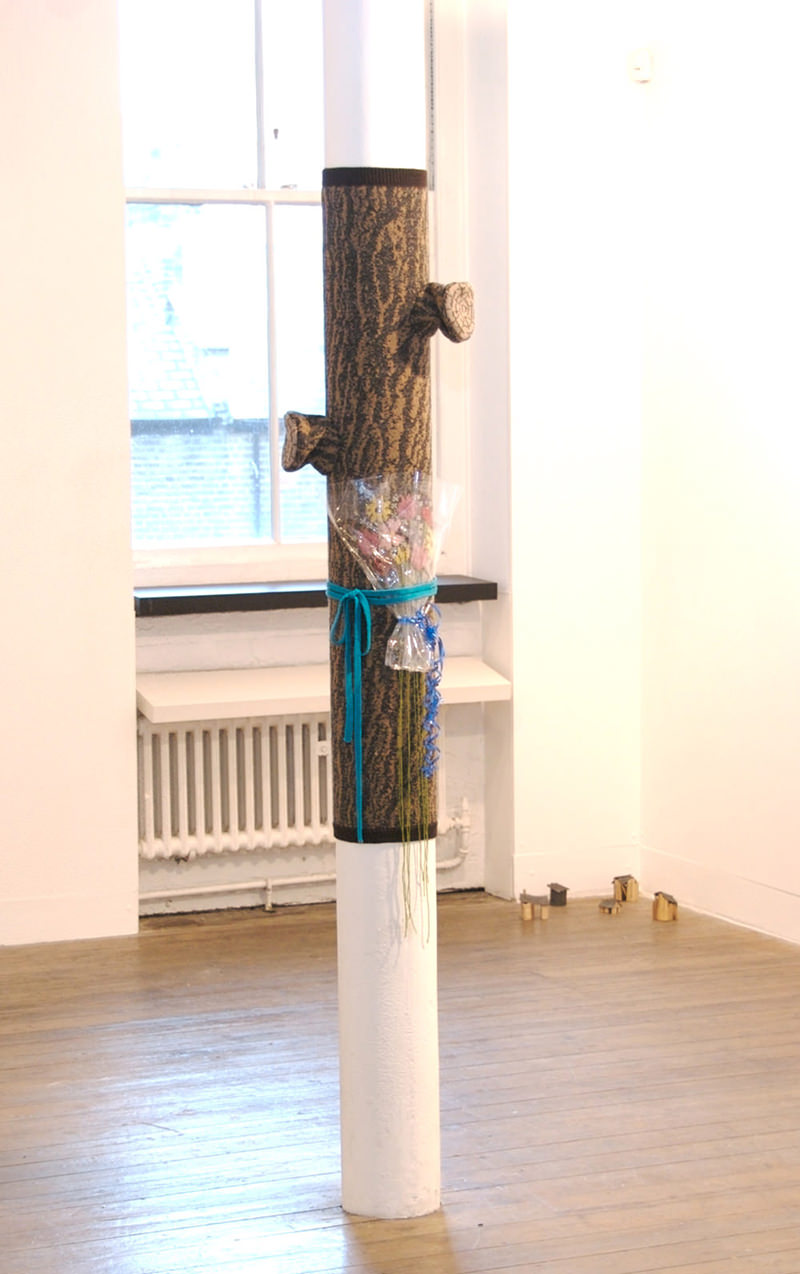
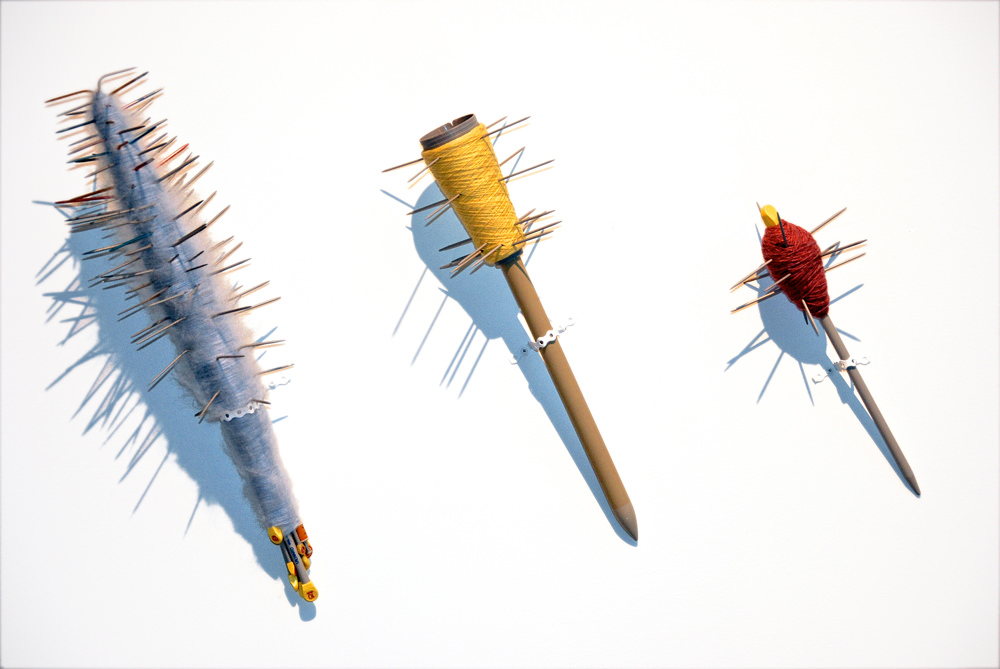
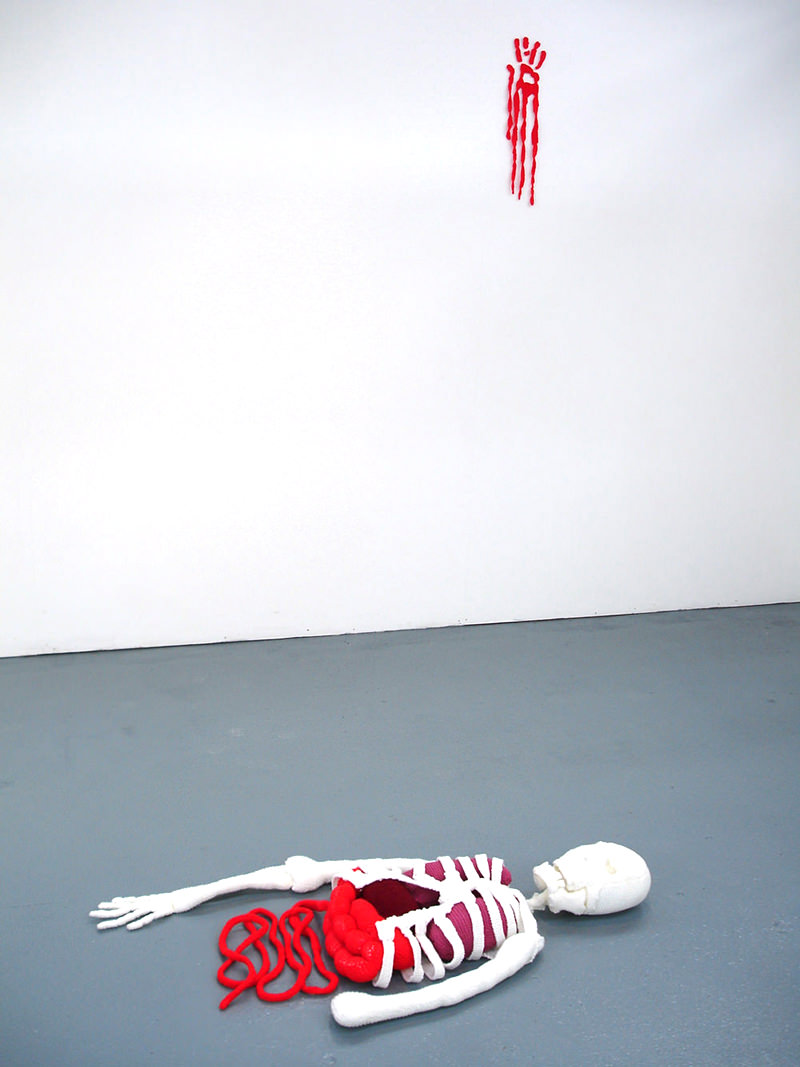
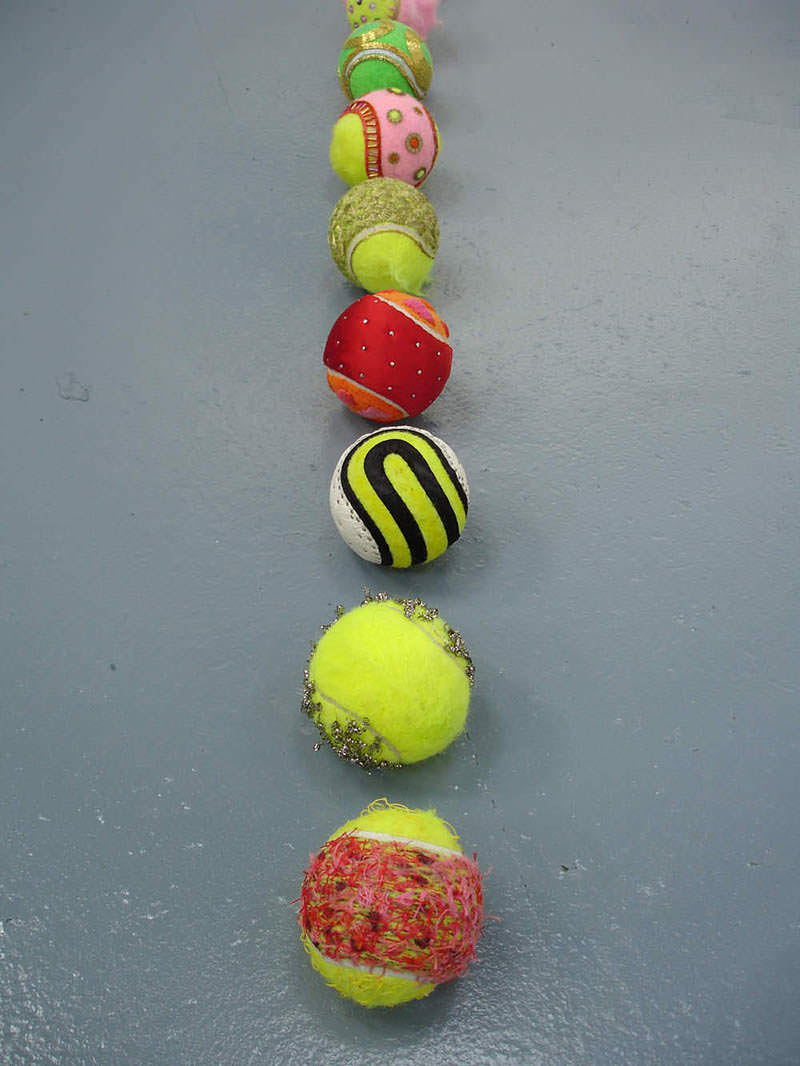
wool, plastic cone, knitting needles
650 × 200 × 200 mm – 400 × 180 × 130 mm

2007
wool, plastic cone, knitting needles
650 × 200 × 200 mm – 400 × 180 × 130 mm
01 May 2007
Widcome Studios Gallery,
24 October – 4 November 2006
Comfortable Place, Upper Bristol Road, Bath
www.bana-arts.co.uk


Exhibitors were Anthony Clark, Alison Harper, Amy Houghton, Janine McLellan and Lawrie Quigley.
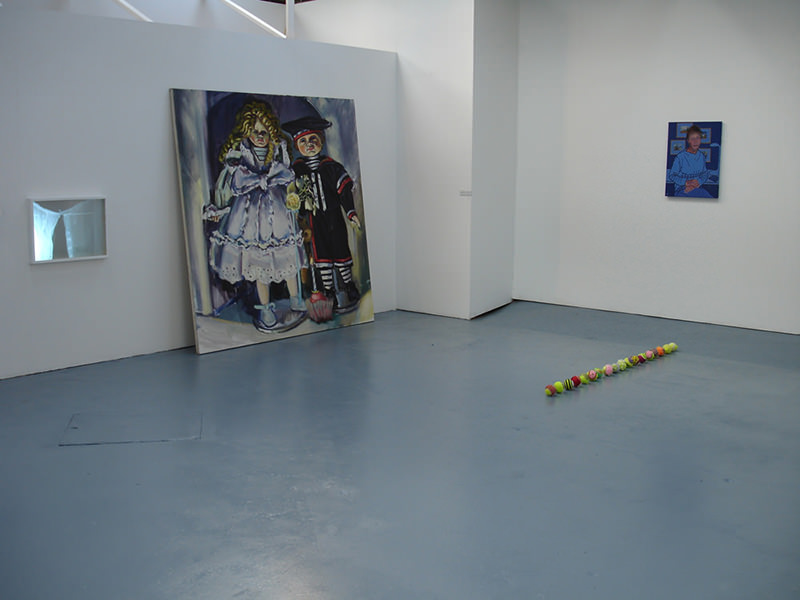
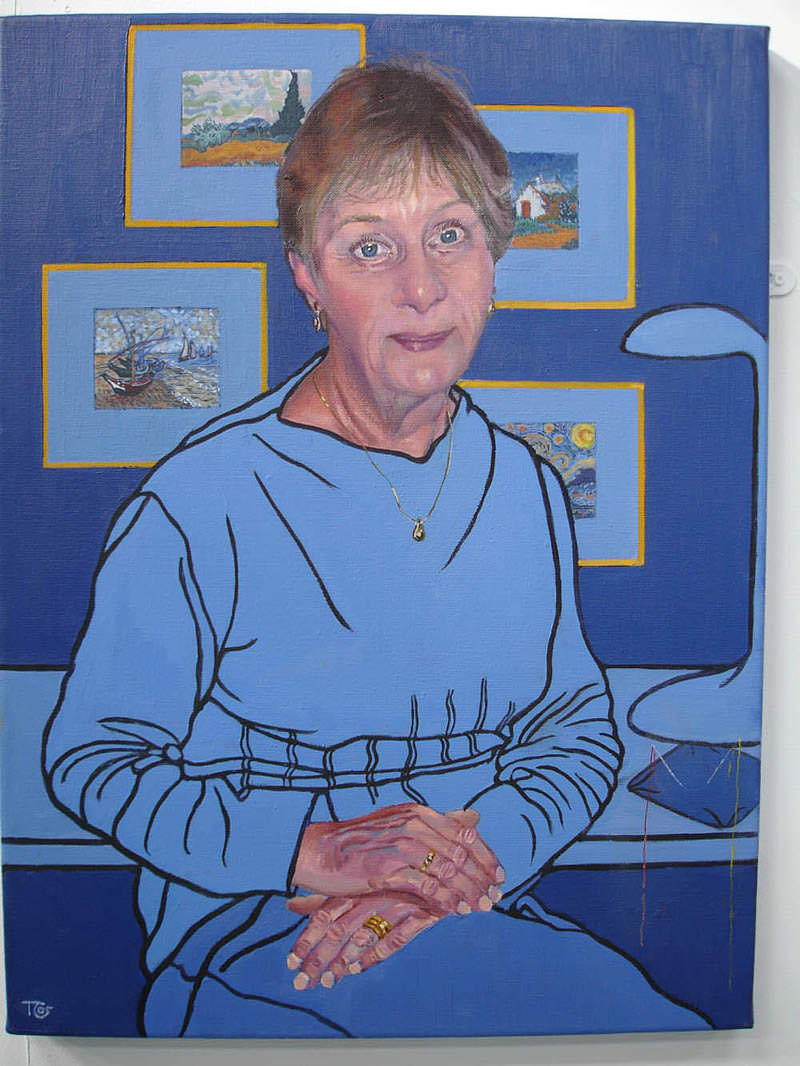
The work submitted for any open submission exhibition is always eclectic. Looking through the submissions is the opening of a Pandora’s Box. You get what you’re given, like it or not, and you have to make a coherent exhibition from it. There were many routes that I could have taken, simply selected my favourite pieces, selected works from just one medium, selected works by just one artist or looked for common themes within the work. I did find quite a few reoccurring themes. There were numerous images related to domesticity – portraits of passive women (many drinking cups of tea), empty domestic interiors and the transformation of domestic objects into art objects. The natural world was a common theme as was the colour yellow.
Unsurprisingly a lot of textile related pieces were submitted but sadly there was little ceramic or sculptural work. Some of the artists had submitted three exceptionally strong works and I could easily have had a solo or two-person show but I wanted to make the show broader and, dare I say it, stranger than that. In the end I decided that I would use the theme of domestic textile production and try to create a dialogue between works by different artists, using different mediums. So there you have it, an exhibition of 7 works (across a range of scales), by 5 artists (3 female and 2 male) at various stages of their artistic careers, in 4 mediums (animation, hand embroidery, hand knitting and painting). An idiosyncratic exhibition of strange and wonderful works that I am very pleased to have been given the opportunity to select. It is always a privilege to see the work of other artists close at hand, especially when you are entrusted with decisions about it.
Several of the pieces I would like to own, one of them I will own and some frighten me so much that I am very glad not to own them. Which is which, is for you to decide. Rather perversely, I did not select my favourite piece. What that was, and who it was by, I will leave to your imagination.
(Essay by Freddie Robins from Partial View catalogue)
24 October 2006
Pump House Gallery, Battersea Park, London
17 August – 9 October 2005
http://pumphousegallery.org.uk
Curated by Freddie Robins and Sandra Ross


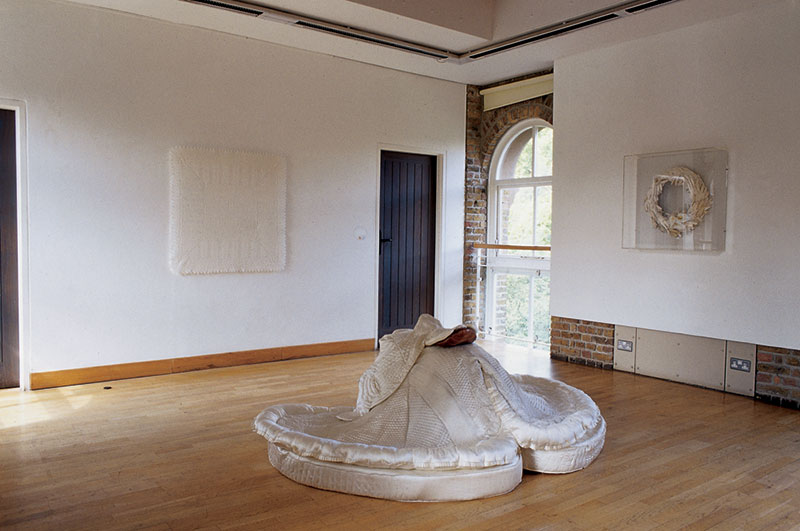
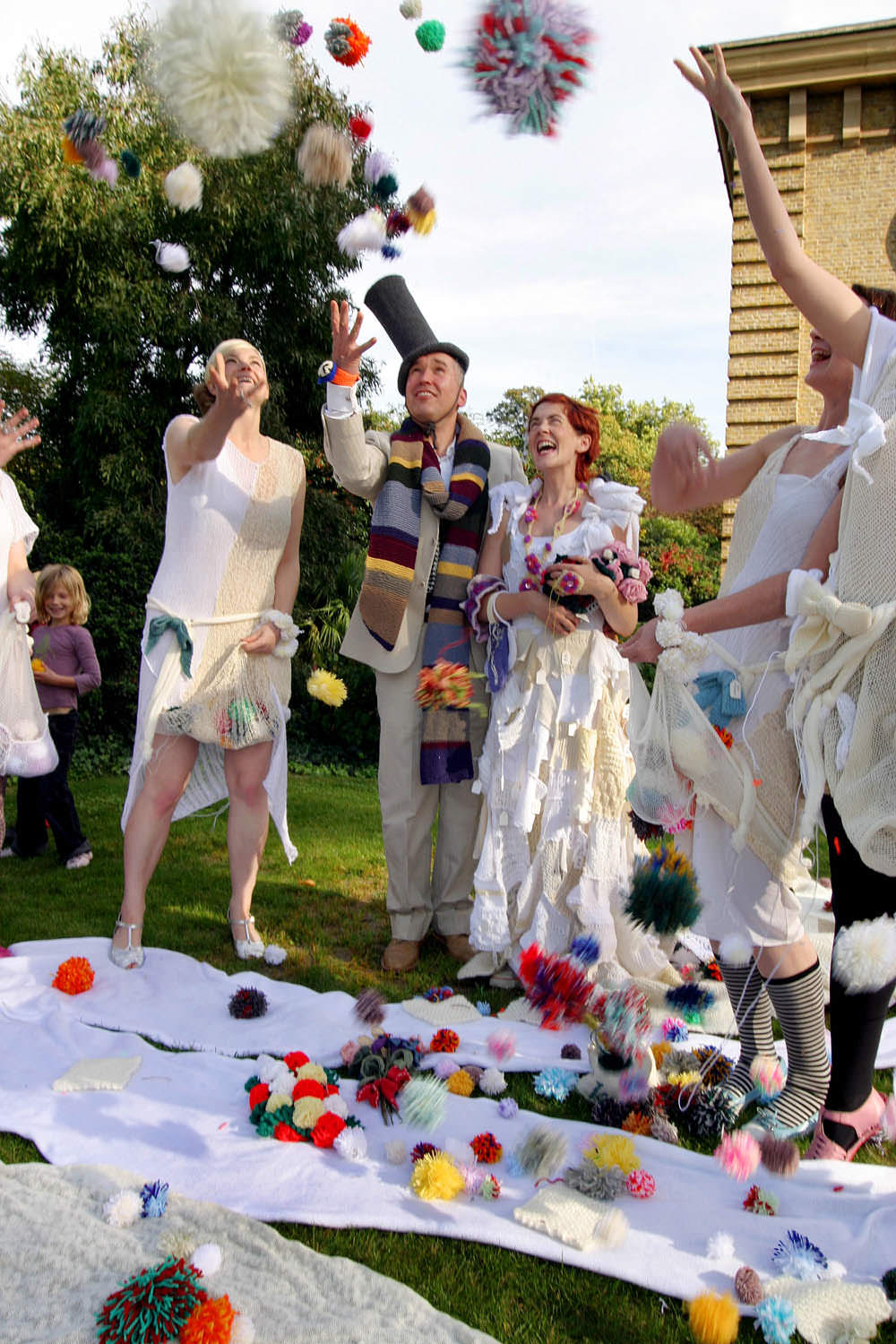
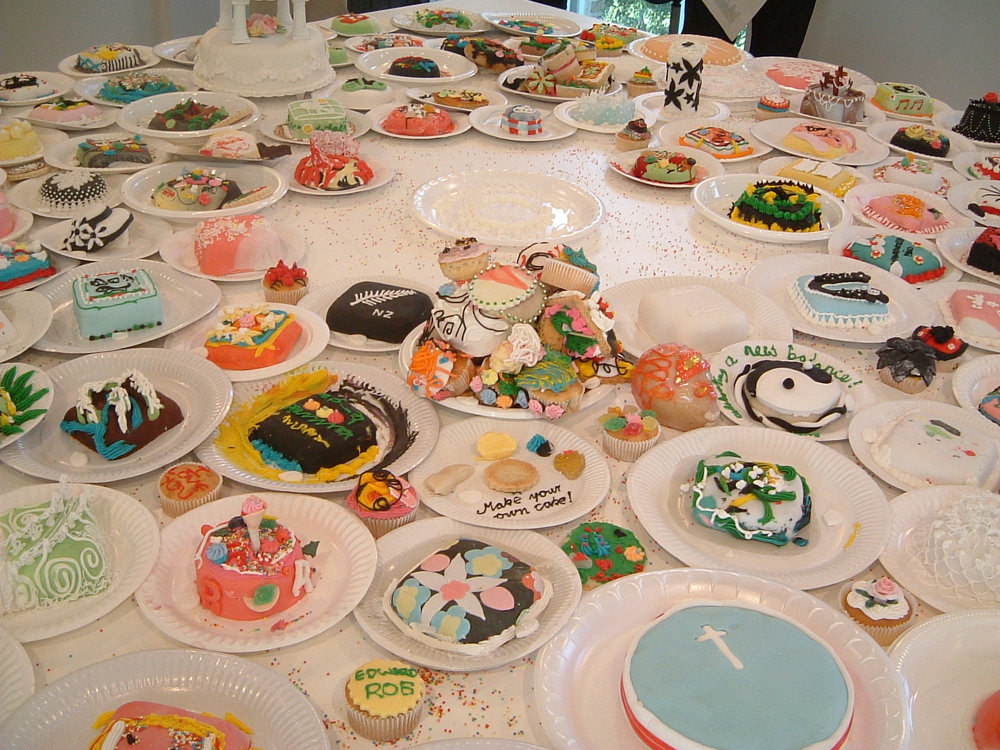
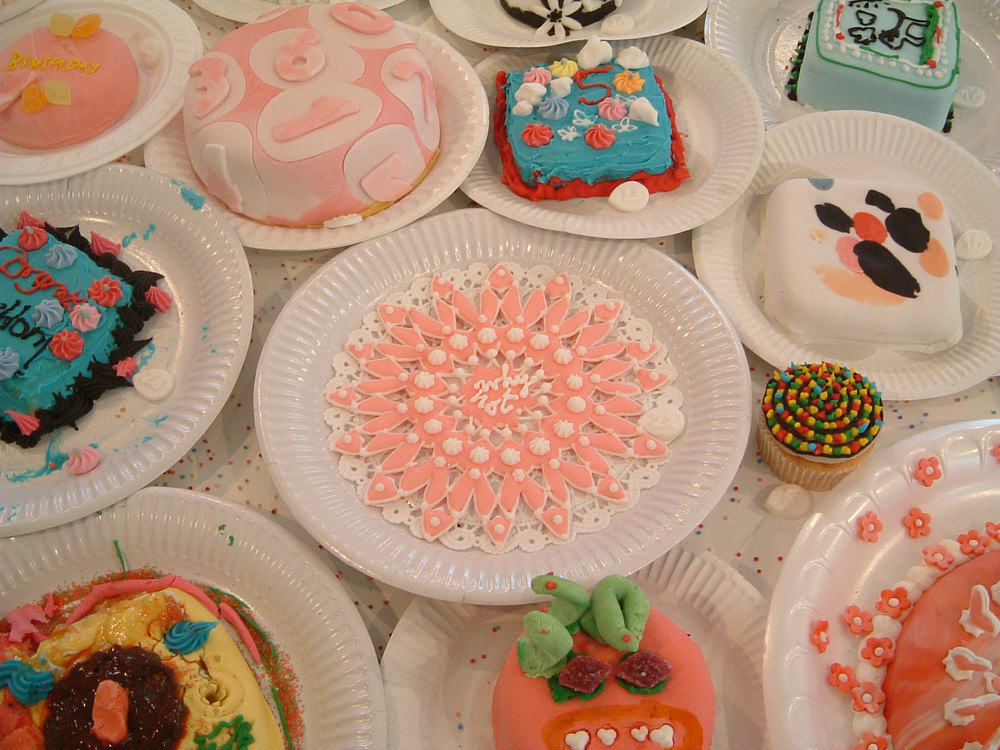
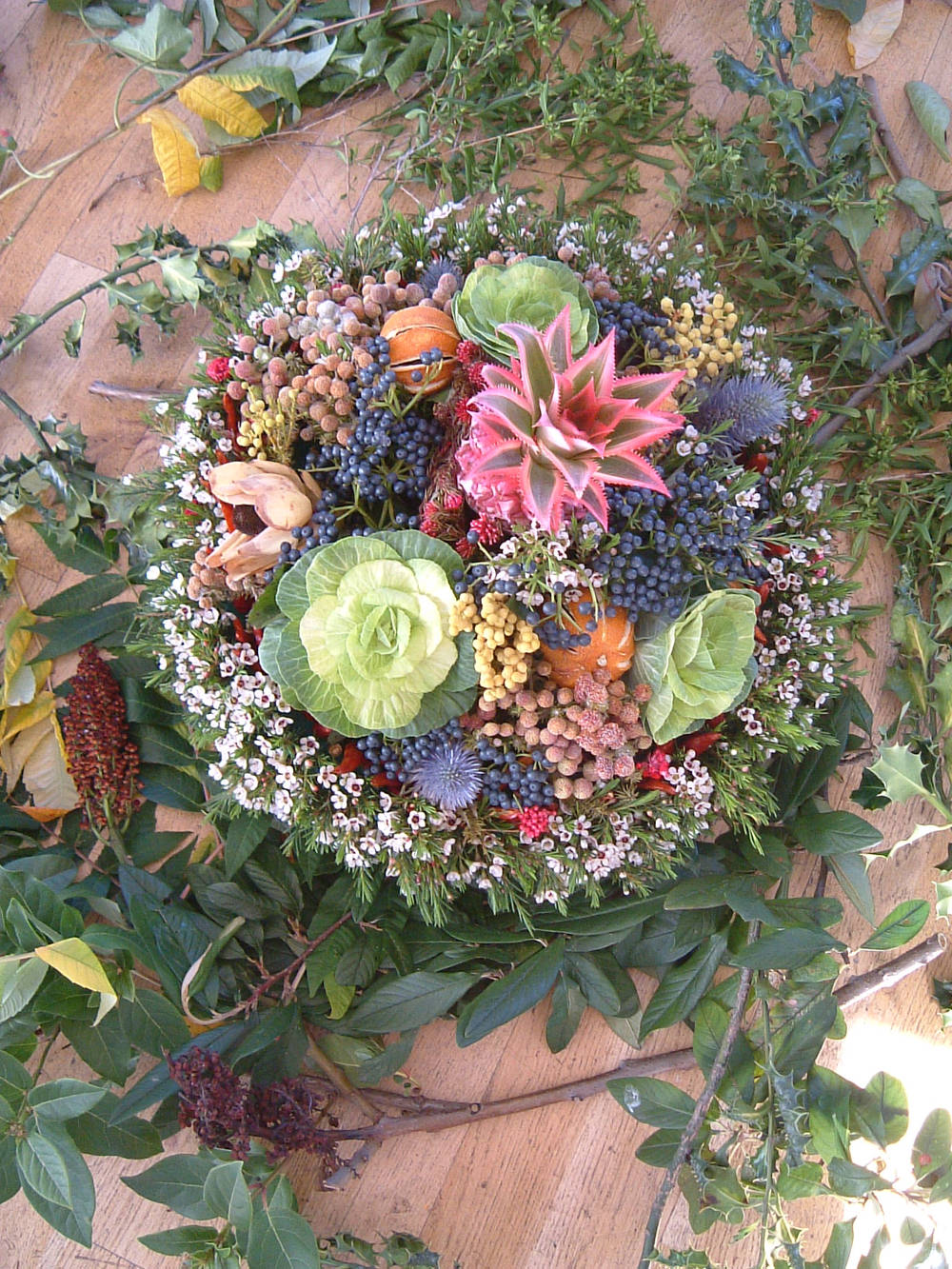
“ Ceremony was born out of a discussion about the relevance, application and value of craft skills in today’s society and the need to platform contemporary craft in visual arts venues, especially in London. An idea that we kept coming back to was the way that unique crafted objects play an integral role in the execution of traditional rites of passage, from the knitted christening shawl to the gold wedding ring and finally the floral funeral wreath. A period of research ensued and after contacting numerous artists, making many studio visits and having discussions with peers about this concept, we devised an exhibition that brought together an eclectic brew of works, performances and projects that explored the performative relationship between object and ritual. Many of the works and projects were especially commissioned for this exhibition and covered a diverse range of practices including cake decorating, metal work, film, knitting, live art, stone carving, quilting and floristry.
As well as exploring the rituals themselves, this exhibition provided a glimpse of the diverse range of craft practices and techniques used by contemporary practitioners. It gave exposure to under-valued skills such as cake decorating, floristry and knitting, and brought into question the traditional hierarchical domains of fine and applied art.”
(Text taken from the Foreward for Ceremony publication, written by Freddie Robins and Sandra Ross.)
Exhibitors were Barby Asante, Elizabeth Callinicos, Rachael Matthews (Cast Off), Tim Davies, Catherine Hawes, Rozanne Hawksley, Julie Henry, Serena Korda, Laura Potter, Freddie Robins , Chris Stewart, Hans Stofer, Shane Waltener and Welfare State International.
17 August 2005

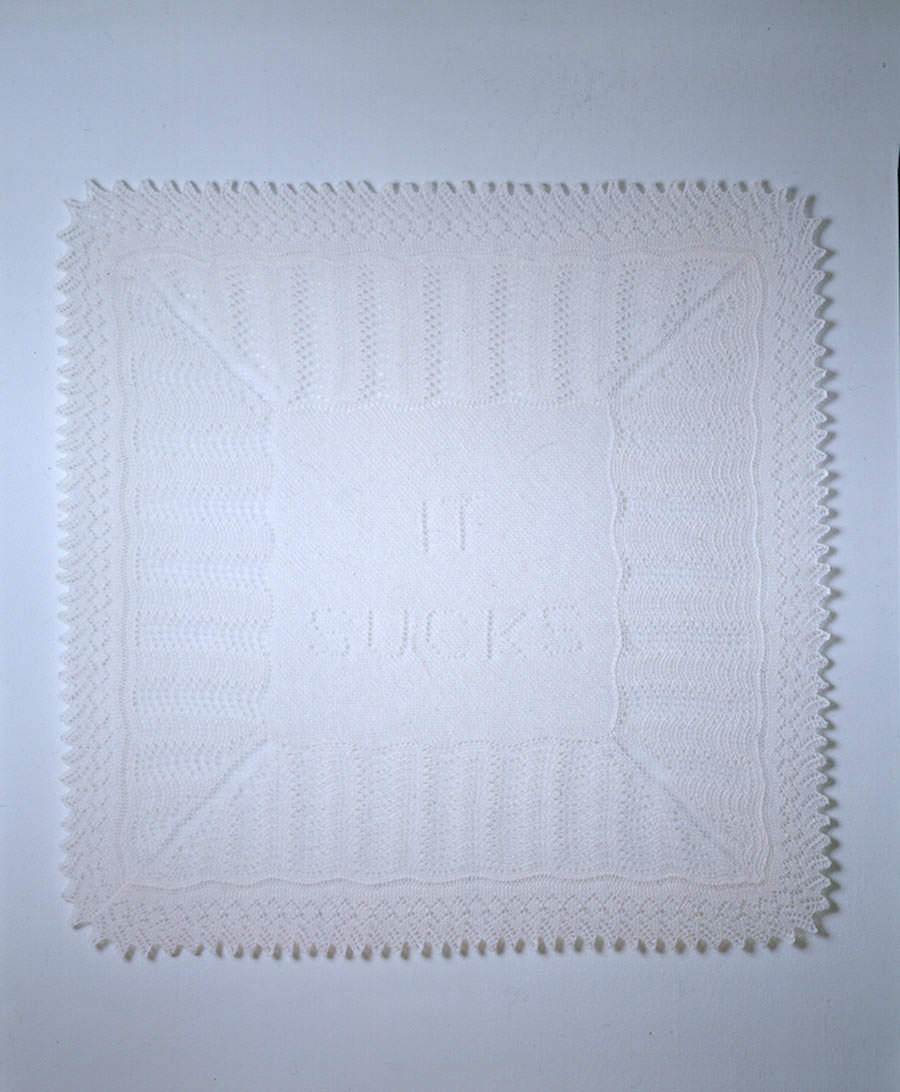
2005
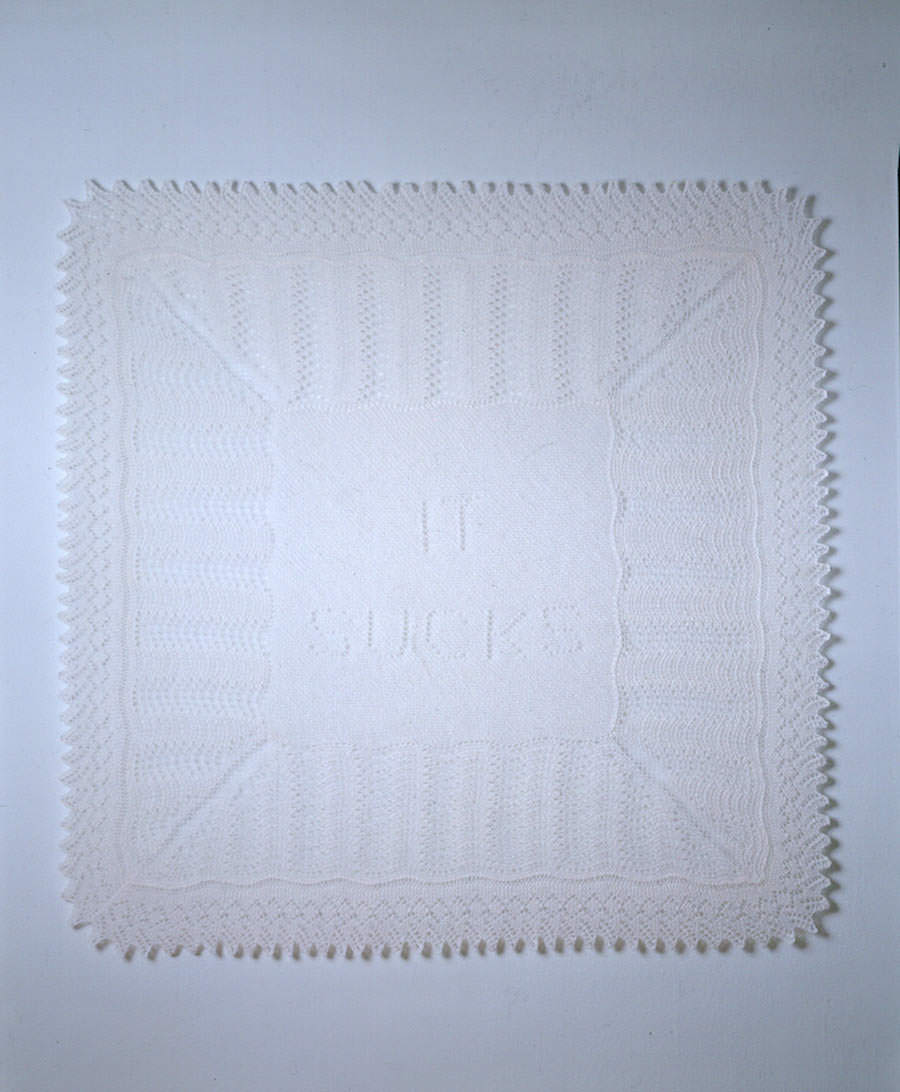
Hand knitted 2-ply Shetland Lace Yarn
1000 × 1000 mm
Knitted by Audrey Yates
Commissioned by Pump House Gallery, London
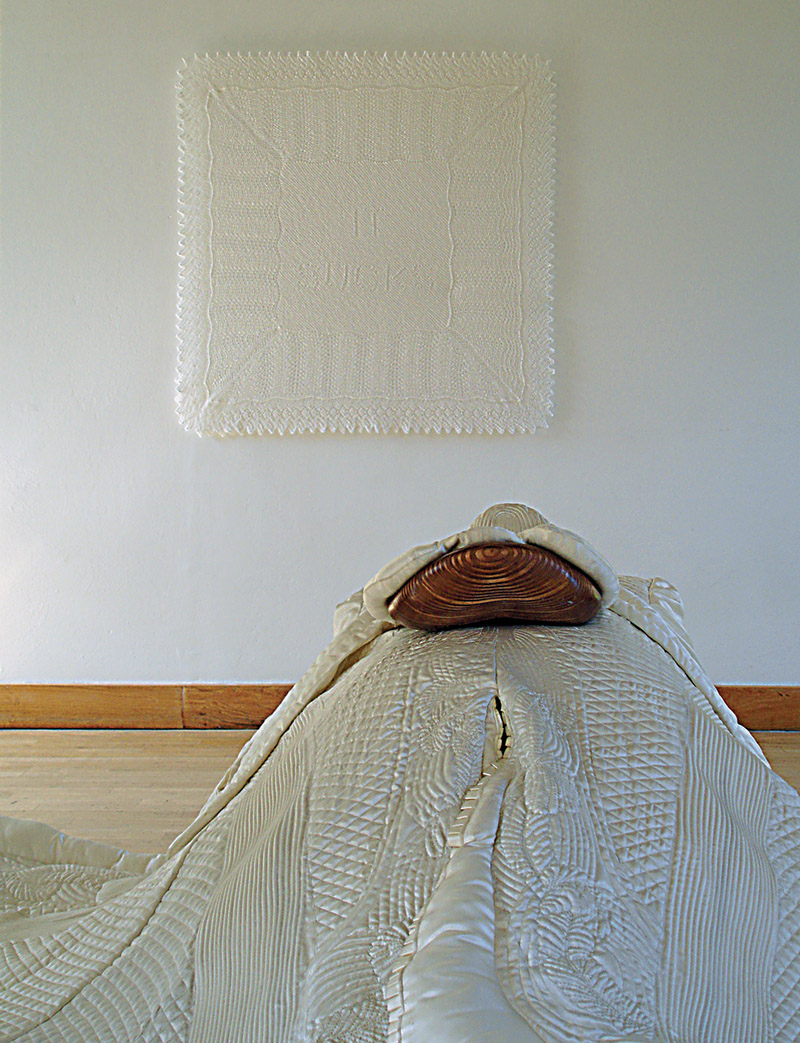
Installation in Ceremony, Pump House Gallery, London 17 August – 9 October 2005. Shown alongside Serena Korda’s Love, Honour and Obey, 2004
My work often employs humour and text to communicate messages. I like to play on words to make visual suggestions. In this commissioned piece, “It Sucks”, I subvert the traditional hand knitted Shetland Lace christening shawl to communicate the very mixed feelings that I had upon the birth of my daughter and becoming a new mother.
Photography: Colin Guilemet
01 May 2005
24 February – 15 May 2005
Crafts Council Gallery, London
www.craftscouncil.org.uk
Touring to: City Gallery, Leicester, Knitting & Stitching Show (Alexandra Palace, London, RDS, Dublin and RDS, Dublin) Oriel Davies Gallery, Powys, Wales
Curated by Freddie Robins and Katy Bevan


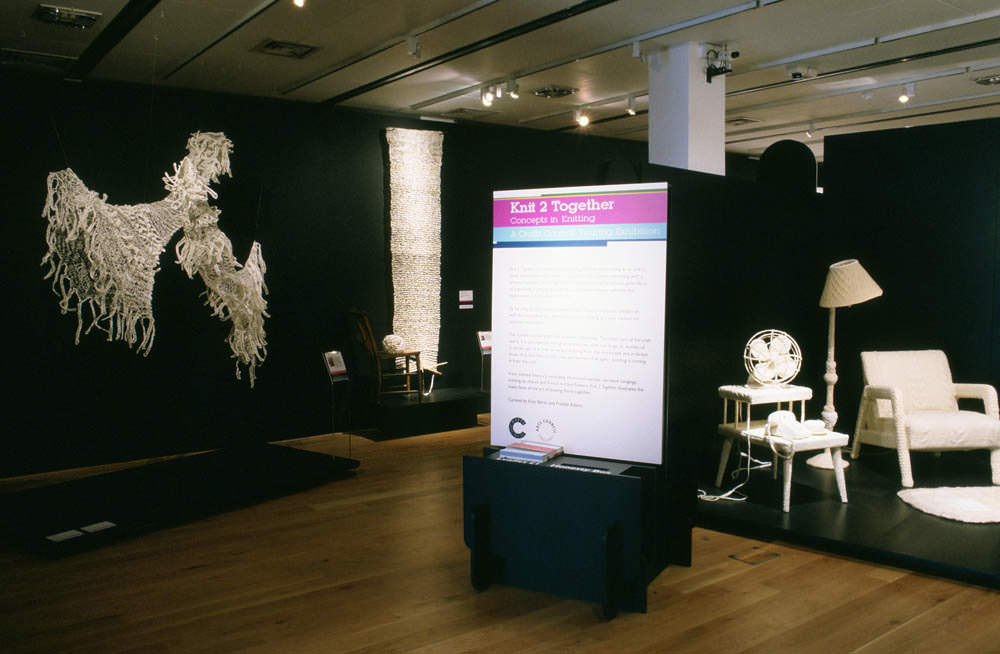
Knit 2 Together: Concepts in Knitting is the first knitting exhibition by the Crafts Council since 1986. It takes a close look at contemporary knitting in art practice, especially work that pushes the perceived boundaries within the world of knitting. By focussing on the possibilities that the craft allows, and emphasizing technique, process, structure and material, Knit 2 Together takes an in-depth look at the individual stitch. Once previous associations are recognised and removed, knitting can be rehabilitated as a first class craft.
The exhibitors are representative of different strands in knitting today, from the self-taught art of Marie-Rose Lortet, to the highly technical digital imagery of Kelly Jenkins. The majority of the exhibitors are based in the UK, while the US, Canada, Japan and France are also represented.”
(Taken from the Crafts Council leaflet for Knit 2 Together: Concepts in Knitting, written by Katy Bevan)
Exhibitors were Andy Diaz Hope, Francoise Dupre, Kelly Jenkins, Ruth Lee, Marie-Rose Lortet, Rachael Matthews, Susie McMurray, Janet Morton, Celia Pym, Freddie Robins, Takehiko Sanada, Stephanie Speight, Jemma Sykes, Shane Waltener and Donna Wilson.
Photography: Ed Barber/Crafts Council
24 February 2005
2004
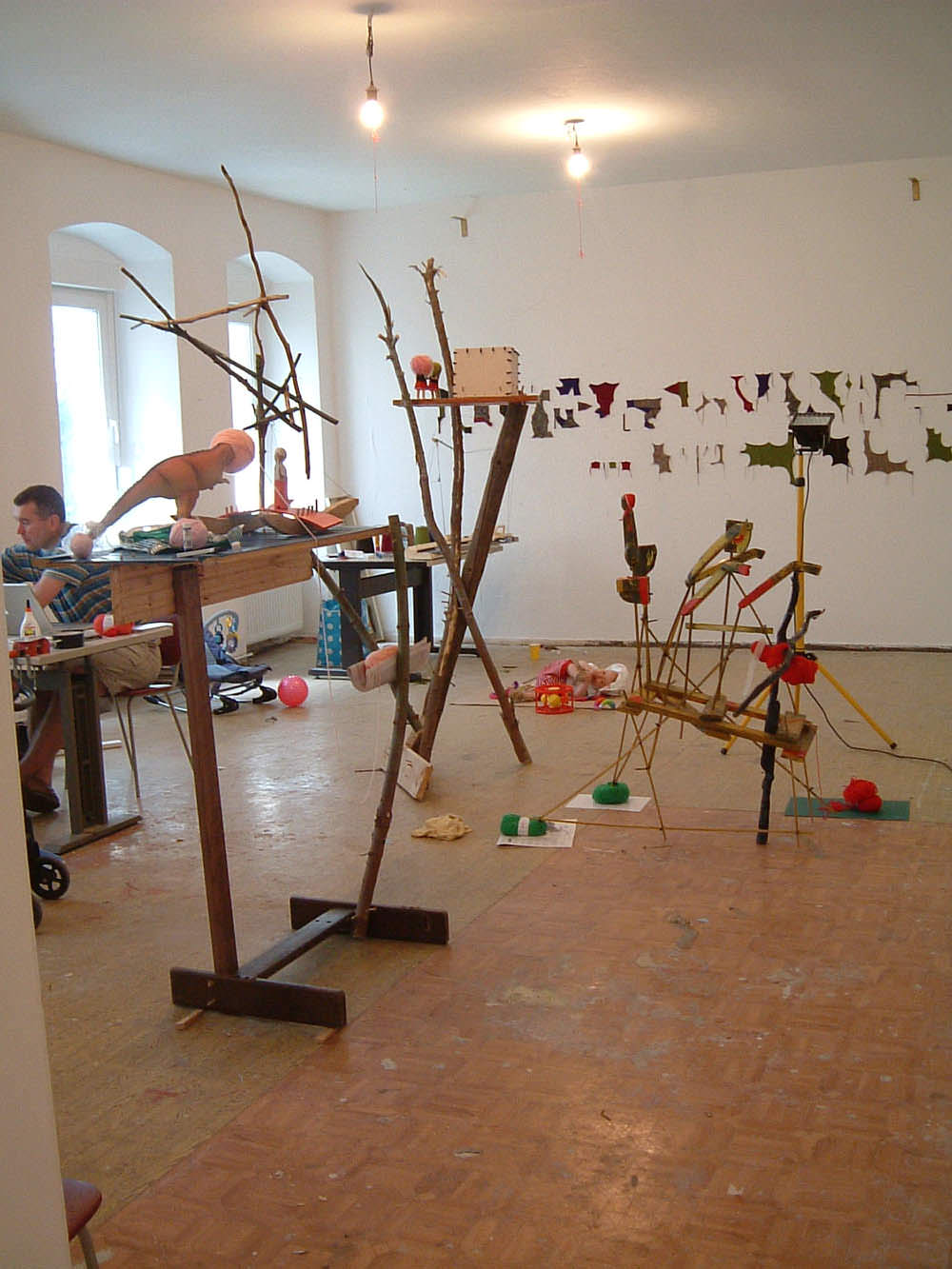
Joint residency with Ben Coode-Adams


Work in progress in studio
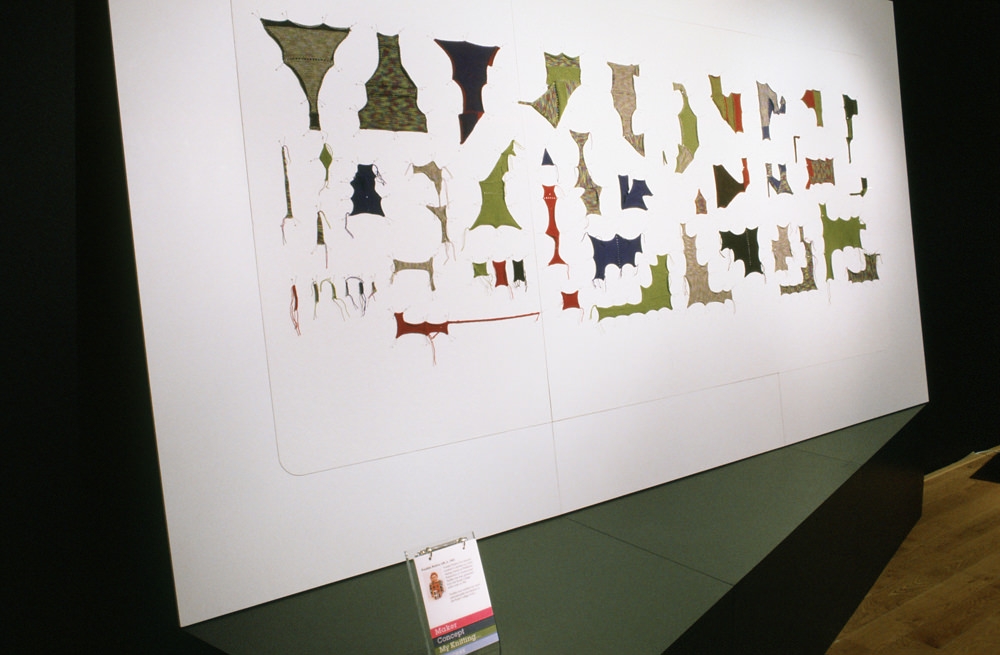
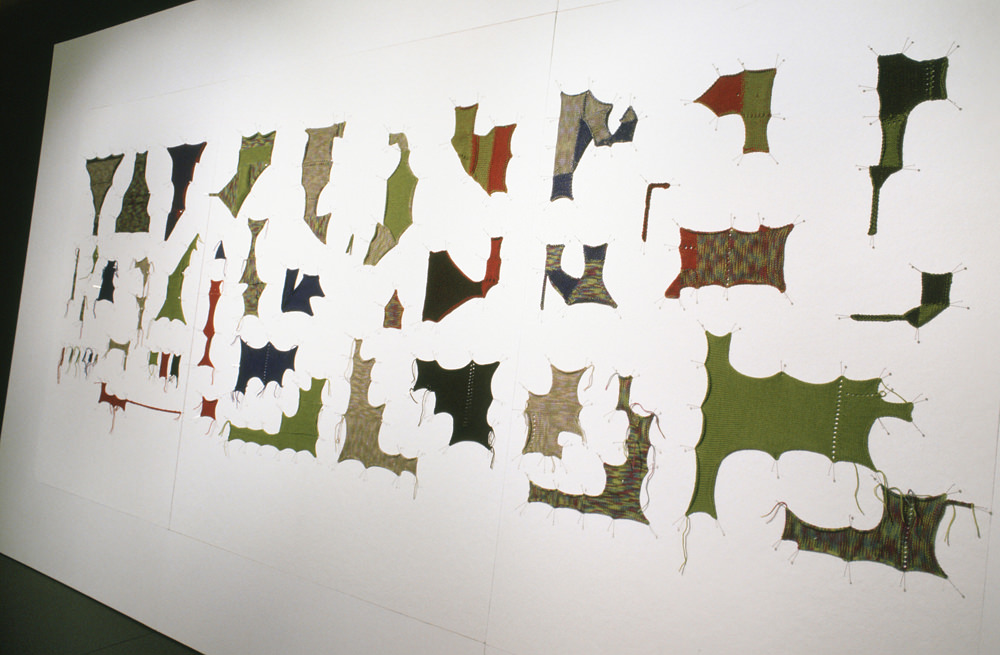
How to make a piece of work when you are too tired to make decisions
2004 machine knitted wool, dress pins
Dimensions variable
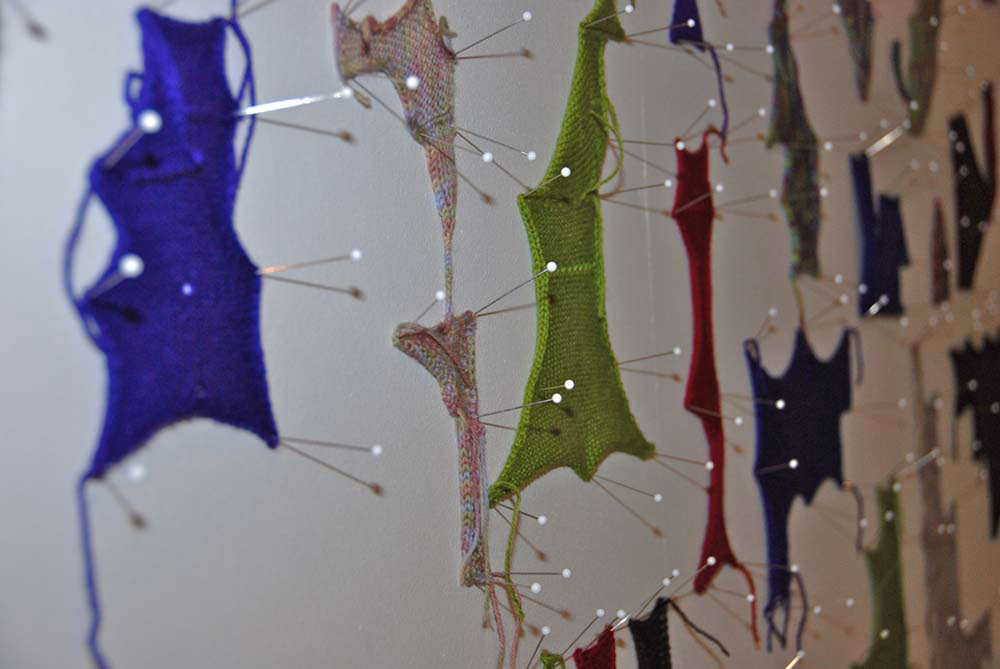
How to make a piece of work when you are too tired to make decisions (detail)
This piece of work was conceived of during the first few months of my daughter’s life when I was lying in bed, over tired but unable to sleep. I knew that when I did manage to make work again it would no longer be possible for me to approach it in the same way that I had before. My studio practice was built on continuity of time and thought, which was no longer available to me. My work is technically challenging and even during my pregnancy I had found it increasingly difficult to make the necessary decisions, let alone do the required mathematical equations. For sometime prior to this I had also been considering how I might go about making abstract pieces, up until this time all my work has been of a figurative nature. My work had also been increasing in scale and I wanted this to continue. With much less time available to me the only way that this was possible was to make smaller components which, when placed together, would form a large work.
This piece aimed to address all of the above. It took the decision making away from me and let it rest on the throw of a dice. It also enabled me to make pieces of work in very short periods of time where continuity of time or thought was not necessary. I could make work when I was tired or even give the dice and instructions to someone else and they could make it for me, no pattern necessary! Although in the past I have adopted a very controlled approach to my studio practice I have always loved serendipity. The idea of making something through chance held great appeal for me.
I used 3 dice, one to decide the colour of the yarns that I would use, one to give me numbers for stitches and rows (3, 4, 8, 12, 15 and 17) and the other to decide the actions: “knit”, “hook up side of knitting”, “turn knitting”, “make row of lace holes then knit”, “decrease 1 stitch fully-fashioned at the beginning of each row” and “increase 1 stitch fully-fashioned at the beginning of each row”. Each individual piece was made using 10 actions. The instructions, numbers dice and actions dice were modified after several experiments to give more consistently successful results. The finished piece is on going. The arrangement of individual pieces can be changed and it can be added to at anytime. The instructions and dice are open to modification should it become necessary or should I feel like it.
01 May 2004

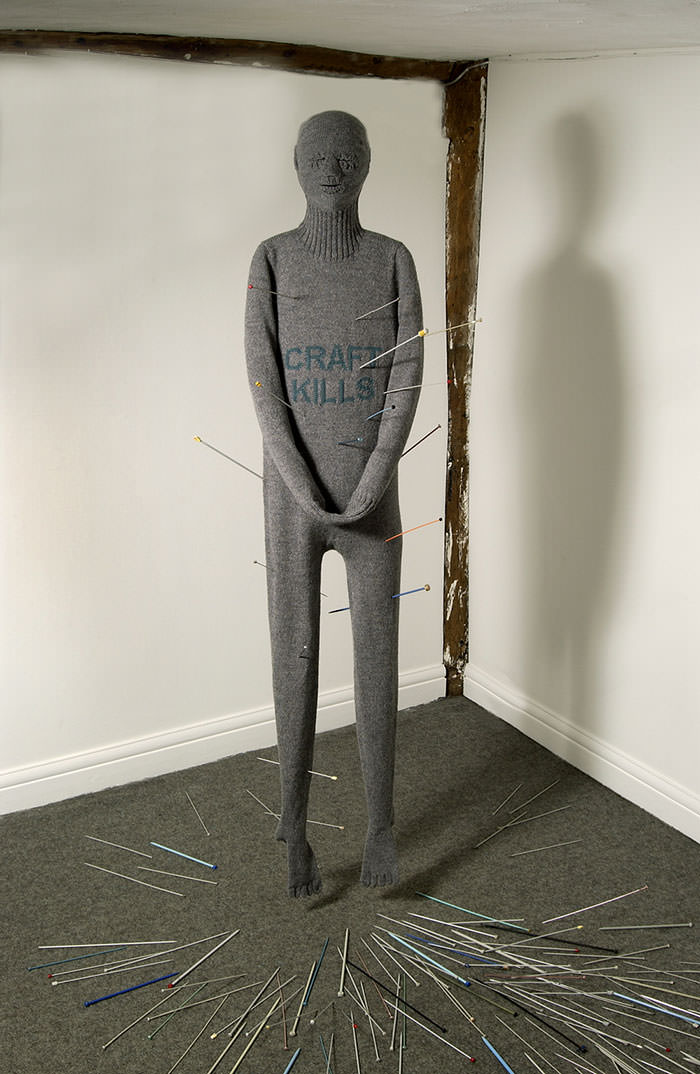
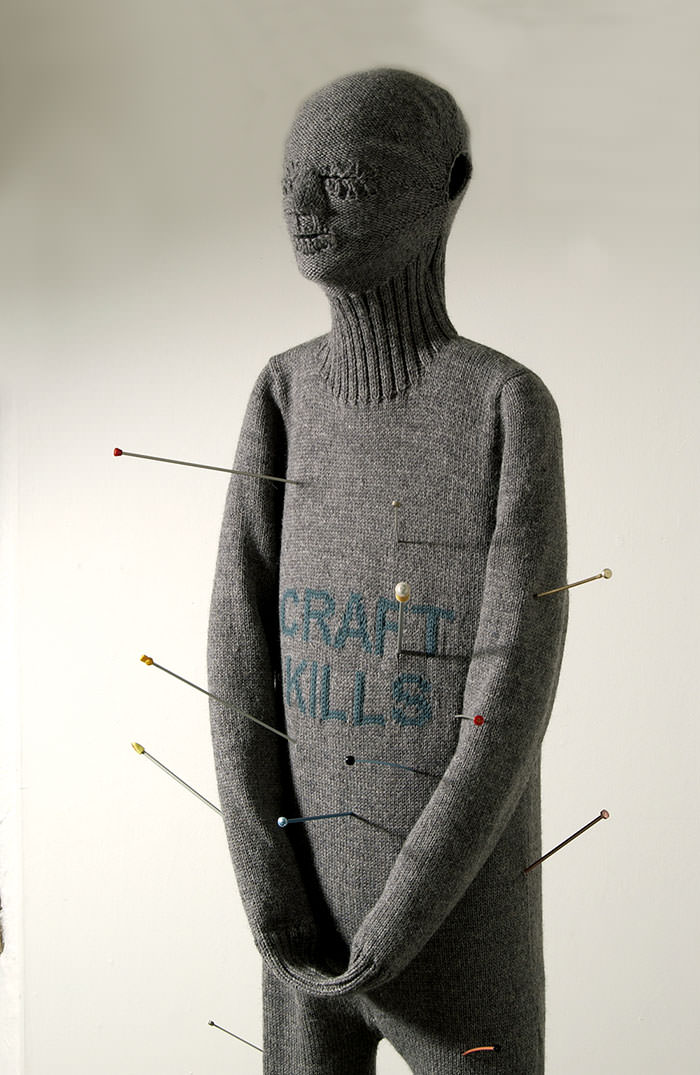
2002
machine knitted wool, knitting needles
2000 × 680 × 380 mm
In the collection of the Crafts Council, London
Craft Kills is a self-portrait based on the well-recognised image of Saint Sebastian being martyred. Instead of arrows piercing my skin I have knitting needles. The title immediately brings to mind the old adage of “dying for your art” but what I am much more concerned with is the stereotypical image that craft, and in particular knitting, has, of being a passive, benign activity. How would it be if craft was considered as dangerous or subversive? Since conceiving of this piece the world suffered the events of September 11th and its aftermath. You can no longer fly with knitting needles in your hand luggage. Knitting is now classed as a dangerous activity.
(Statement written for Flexible 4: Identities catalogue, 2004)
Photography: Douglas Atfield
07 June 2003


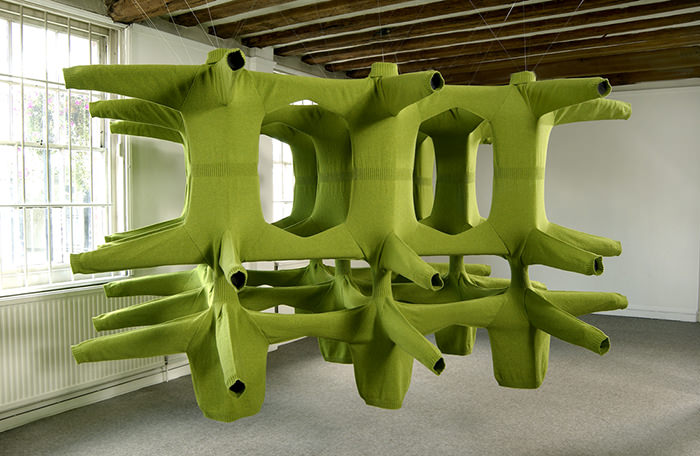
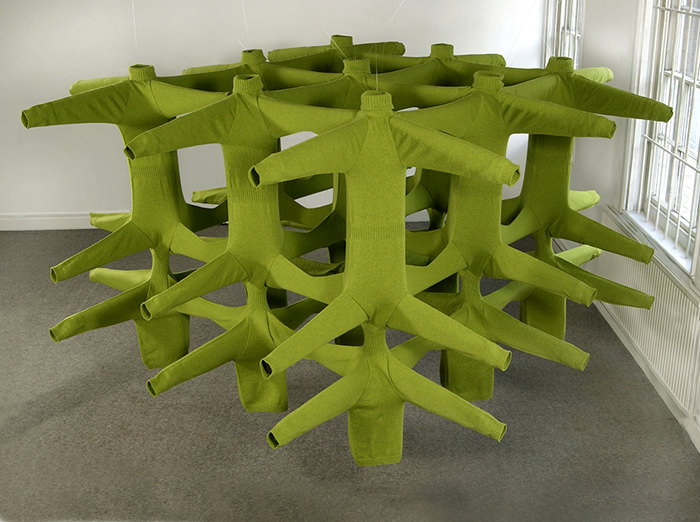
2002
machine knitted wool
1650 × 3000 × 3000 mm
Installed at firstsite at the Minories Art Gallery, Colchester
In the collection of the Castle Museum, Nottingham
Computer Aided Design and knitting development by Kate Sayer and Kim Mitcham at the William Lee Innovation Centre.
The William Lee Innovation Centre (WLIC) is a multi-disciplinary research centre in fibre structural assembly based at The University of Manchester (formerly UMIST). The centre supports artists and designers working with fibre and textile structures to make the most of virtual garment engineering. The WLIC closed in 2007. Made with financial support from London Arts and Goldsmiths College, University of London.
Photography: Douglas Atfield
07 June 2003

2002 Hand knitted wool, quilted lining fabric
Knitted by Jean Arkell
Commissioned by firstsite. Installed at firstsite at the Minories Art Gallery, Colchester
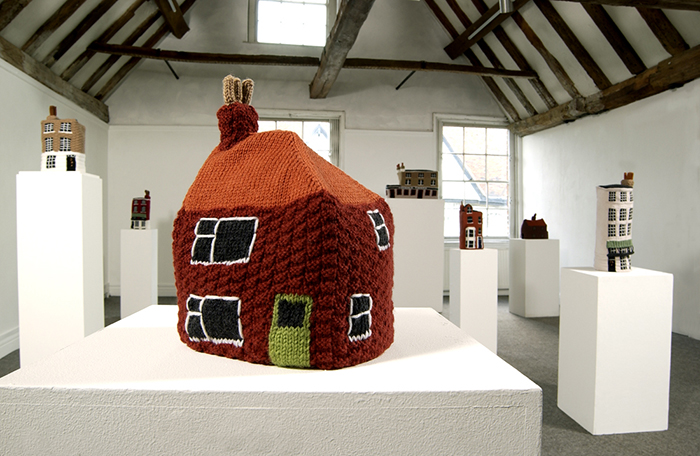
These are the homes of female killers or the houses where they committed their crimes.
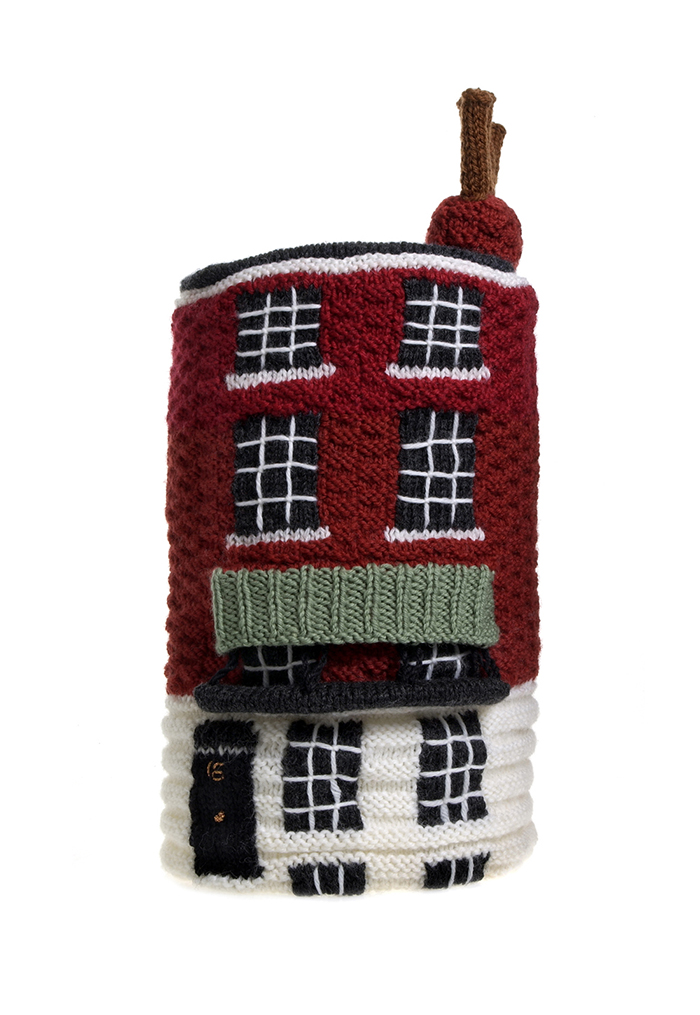
Christiana – 20 hours
16 Gloucester Place, Brighton, East Sussex – 1871
Mrs. Beard – 21 1/2 hours
64 Grand Parade, Brighton, East Sussex – 1871
Christiana Edmunds was a 43 year-old spinster who lived with her widowed mother. She had become infatuated with a married man, Dr. Beard. In September 1870 she brought a box of chocolates to the Beard’s house and insisted that Mrs. Beard eat some over a pot of tea. Christiana had filled these chocolate creams with strychnine. Immediately after eating one Mrs. Beard became severely ill. As a result Dr. Beard accused her of trying to poison his wife. Christiana denied the charge and set about trying to prove that there was a poisoner at large in Brighton. She would pay children to buy chocolate creams from the same sweet shop that she purchased the box of chocolates for Mrs. Beard from. She would inject these with strychnine, then re-wrap them and pay another child to return them. The innocent shop-keeper sold on these poisoned sweets. On 12 June 1871 this activity resulted in the death of 4-year-old Sidney Barker. Christiana even sent poisoned cakes and fruit through the mail, addressing some to herself, to try to emphasise her innocence. She was eventually caught and sentenced to death but when it transpired that she was mentally ill her sentence was commuted and she was sent to Broadmoor. She died there in 1907 aged 79. It later transpired that no less than four members of her immediate family had died as a result of mental illness.
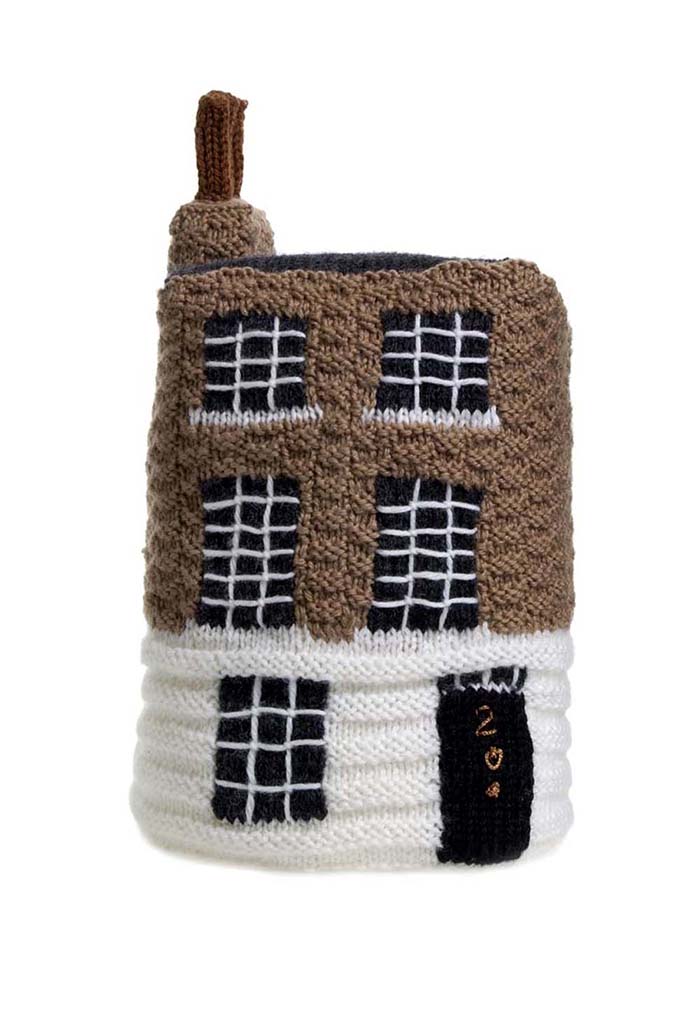
Eleanor – 13 hours
2 Ivor Street (formerly Priory Street), Camden, London – 1890
Mary Eleanor Wheeler, aged 24, was living with a Charles Creighton under the assumed name of Eleanor Pearcey. She was having an affair with a married man, Frank Hogg. On 24 October 1890 she invited his wife Phoebe to tea. In her own kitchen she battered Mrs. Hogg over the head with a poker and then slit her throat. She also killed the Hoggs’ 18-month-old baby daughter who Mrs. Hogg had brought along with her. Eleanor put the bodies into the baby’s pram. When it was dark she pushed the pram around disposing of the two bodies as she went. She was soon caught. Despite her claims that the blood in her kitchen came from a session of mouse killing she was found guilty and hanged at Newgate Prison on 23 December 1890. Her father had been hanged ten years earlier. Her last request was for a mysterious advertisement to be placed in a Madrid newspaper. It read “M.E.C.P. Last wish of M.E.W. Have not betrayed”
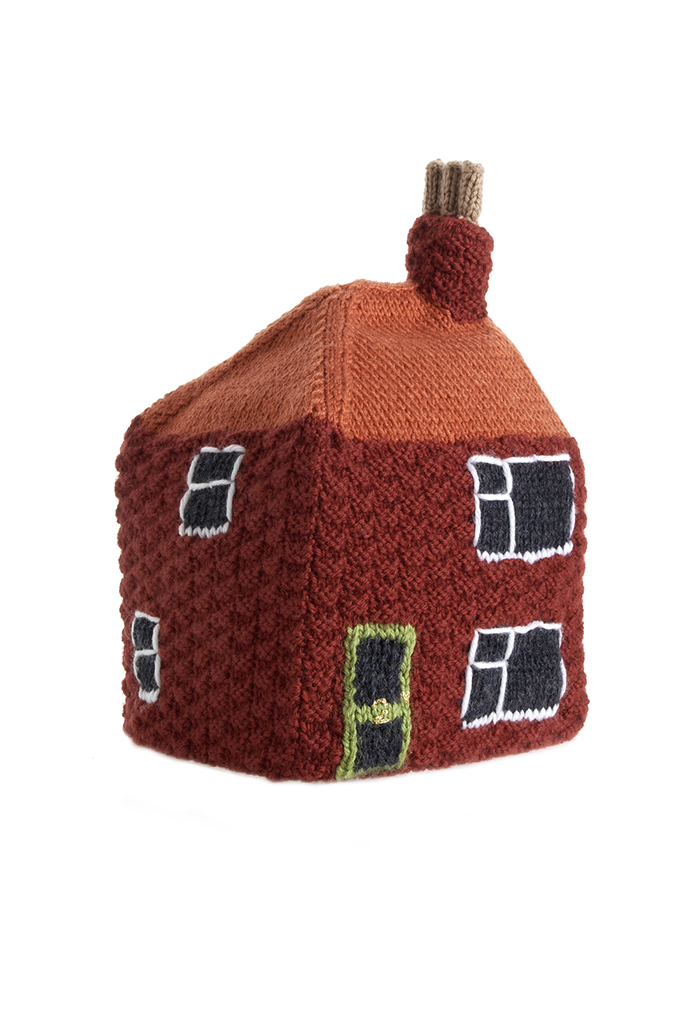
Ethel – 10 hours
2 Council Houses, Kirkby on Bain, Lincolnshire – 1934
Ethel Major, aged 43, lived with her husband Arthur. In 1934, after 16 years of marriage and a child of their own, Arthur discovered that Ethel already had an illegitimate daughter, Auriel. Their marriage started to deteriorate and Ethel began to imagine that he was now having an affair. As a result of her suspicions she started to poison him. Arthur eventually died on 24 May 1934 after eating corned beef sandwiches containing strychnine. Ethel was caught on the day of Arthur’s funeral when the police received an anonymous letter claiming that a neighbours dog had died after eating scraps of food from the Major’s household. After an examination of Arthur’s body and the exhumation of the dog she was charged. Ethel was found guilty of murder and hanged at Hull Prison on 19 December 1934.
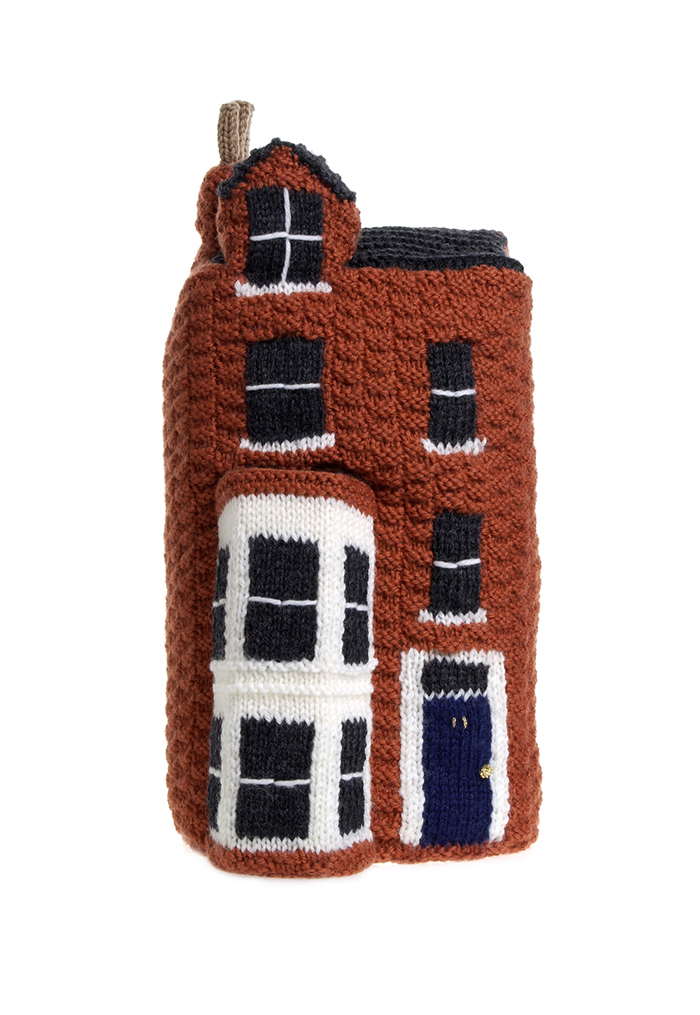
Styllou – 22 1/2 hours
Ground Floor, 11 South Hill Park, Hampstead, London – 1954
Styllou Christofi, a 52-year-old cypriot woman, murdered her german daughter-in-law, Hella, at the family home on 28 July 1954. Styllou had moved from Cyprus to live with her son and his family but problems soon arose. Styllou became increasingly jealous of her daughter-in-law and ended up hitting her over the head with an ash-plate from the stove, strangling her, soaking her body in petrol and setting fire to her in the back garden. Styllou, who spoke little english, raised the alarm, stating that she left Hella in the kitchen, went to bed but was woken by the smell of smoke. She was hanged at Holloway Prison on 13 December 1954. After her death it transpired that in 1925, when Styllou was a young woman, she had been acquitted of murdering her own mother-in-law.
Charlotte – 14 1/2 hours
Coombe Farm Cottages, Sherborne, Dorset – 1935
Charlotte Bryant, a 33-year-old illiterate mother of five, lived here with her husband Frederick. She enjoyed a drink and had a reputation as an amateur prostitute in the local pubs. Apparently her toothlessness and lice did not put the men off. Sometimes she even brought them home. One of these men was Leonard Parsons, a gypsy horse trader. Leonard became an occasional lodger in the Bryant household and Frederick did not seem to mind sharing Charlotte with him. Charlotte decided otherwise and started poisoning Frederick so that she would be free to marry Leonard. Frederick eventually died on 22 December 1935 after drinking a cup of Oxo containing arsenic. Charlotte was caught after the post-mortem on Frederick’s body. A friend also told the police that she had seen Charlotte trying to destroy a tin of weed-killer. She was hanged at Exeter Prison on 15 July 1936.
Ruth – 42 hours
The Magdala Tavern, South Hill Park, Hampstead, London – 1955
This is where 28-year-old Ruth Ellis shot her lover, racing driver David Blakely. Ruth, a twice married night club manageress, had been involved in a stormy relationship with Blakely for two years. When he tried to free himself from her she could not bear it and got herself a revolver to put an end to him. Spotting his van outside The Magdala Tavern on the evening of Sunday 2 April 1955 she waited for him to return. At 9.00pm, as he approached his van, she called out his name and shot him. As he tried to run away she shot him three more times. Apparently his blood mixed with the beer from a pierced flagon, that he was carrying, to make a frothy red river trickling down the gutter. There was much controversy surrounding this case. Just before she died she gave a sworn statement that her new lover , and friend of Blakelys, Desmond Cussen, had encouraged her to shoot Blakely. She was hanged at Holloway Prison on 13 July 1955, seven months after Styllou Christofi. She was the last woman to be hanged in Britain.
Curiously the last two women to be hanged in Britain, Ruth Ellis and Styllou Christofi, committed their crimes in the same road.
Photography: Douglas Atfield
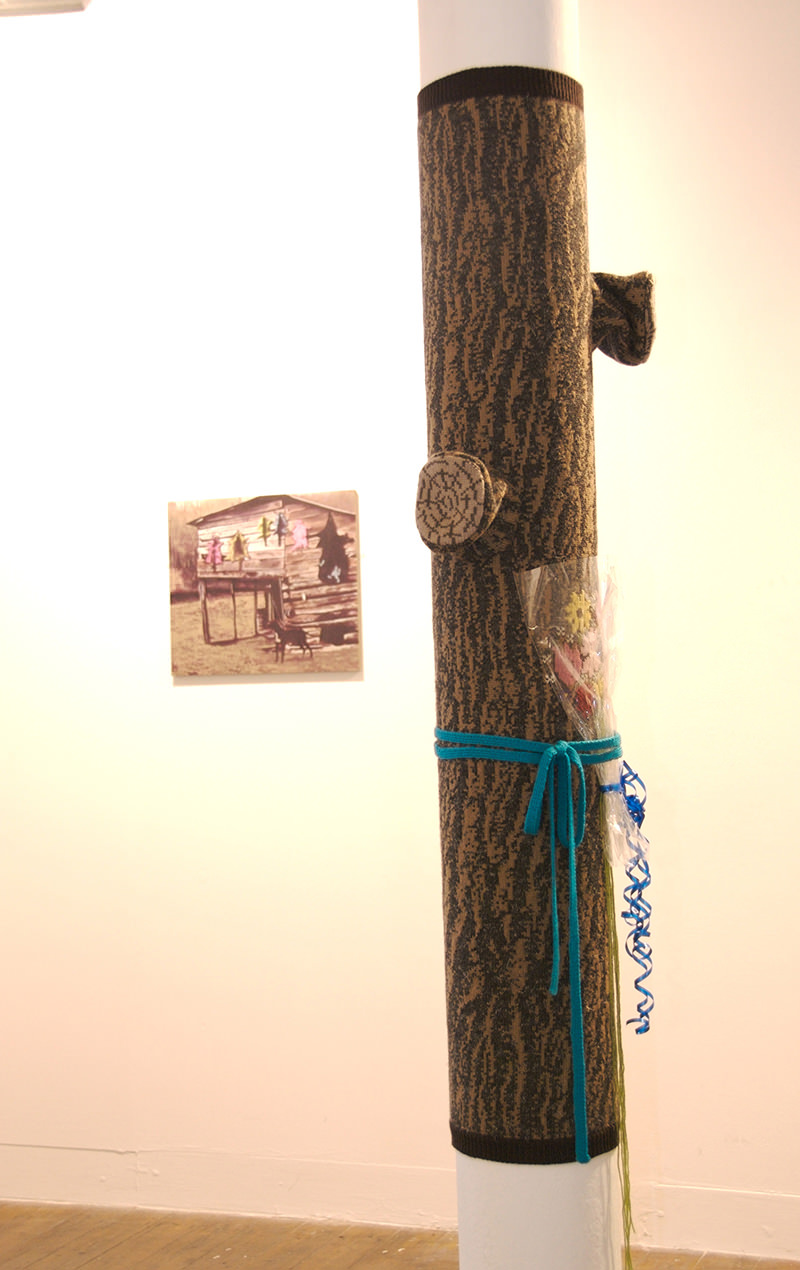
07 June 2003


Forearmed
2002
machine knitted wool
1360 × 1360 mm
Forewarned
2002
machine knitted wool
1920 × 1360 mm
In the collection of the Castle Museum, Nottingham
Photography: Douglas Atfield
07 June 2003
Page 5 of 8